 |
| Publicity and photos from 1973 speech |
 |
| Click on photos to enlarge |
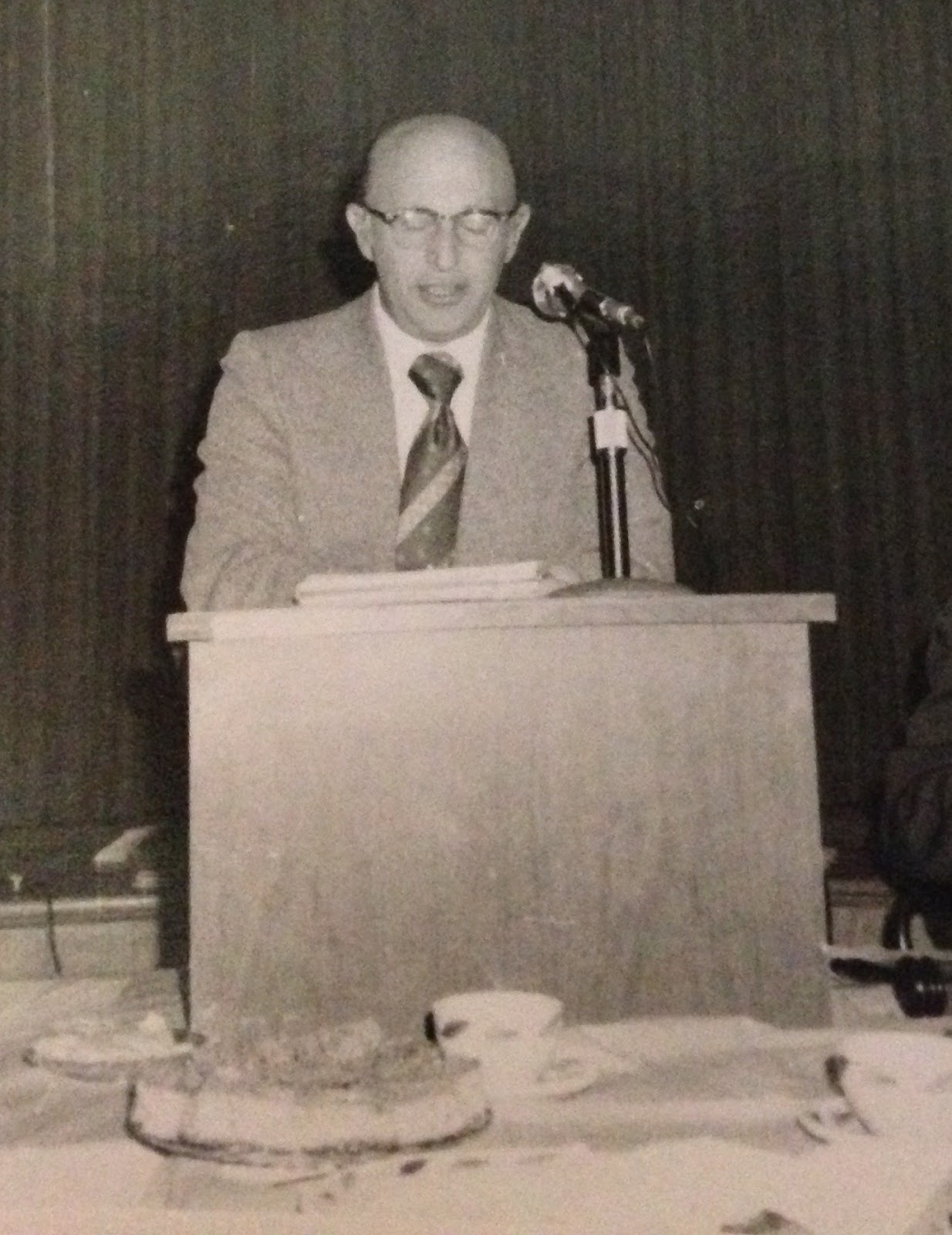


Do you remember ’73? Two weeks after President Nixon’s second inauguration, on Feb. 4, 1973, Harry delivered the following speech at a D.C.-area synagogue event. He was 52. After he died, I noticed the audio cassette tape of the speech mixed in with his music collection. It’s valuable now since we have so few recordings from those days. The transcript below is long and conversational, and you can only imagine his tone quite forceful in spots – so typical of Harry. However, much of his advice and his analogies seem timeless. And his humor, well, it’s so Harry, too.
Speaker Introduction
“How to Read Between the Lines”
I do have to say Dan, when I get an introduction like that I can’t help wishing my parents could have been here, because my father would have really enjoyed it, and my mother would have believed it.
 |
| More photos on this page of Harry in the workplace, 1970s |
You see the problem with the press is it’s not unique to this country. I read this little item not long ago about Queen Elizabeth when she went to France recently. She was really shocked to learn about her image as projected in the French press, and she made a count. In the French media, she had been reported as being pregnant on 92 separate occasions. She had suffered 149 accidents; had 9 miscarriages; abdicated 63 times; was on the verge of breaking up with Prince Philip 73 times; on the edge of a nervous breakdown 32 times; and had 27 attempts on her life.
That’s the way the press operates most all the way around the world. But I don’t want to talk about the lies; they’re relatively easy to spot. Like Mark Twain once said, “It ain’t what you don’t know that makes you a fool; it’s what you do know that ain’t so.” And that’s what’s happening.
* * *
Now the manner in the way the press handles the news these days has been dubbed as “news-think”. News-think is a frame of mind. What the press is trying to do is put news in the paper; whether it’s news or not, everything has to be labeled news. And this is what we have to worry about. It’s not so much that what we read is the real story about what’s going on; it’s whether it’s a story at all. Because the news is filled with non-stories. And the way to make a non-story look like a story is to put a headline on it, a byline, and sometimes a date line. But any of them could have been written within a period of about 20 years.
In fact, we had some research we had to do not long ago comparing some stories about Vietnam with some of the stories about Korea. And would you believe that in 1952 as in 1972, you could not have told the difference between the stories on Korea and the stories on Vietnam? I think some of the newspapers simply lifted some of the stories out and changed a word here and there. So you have to worry about whether something is a story.
* * *
Also they have a great many subtler devices. You take some of the words they use, the headline writers. They use: attack, accuse, hit, denounce, berate. So you don’t just make a comment or two about a city master plan, you assail it. Even if all you did was scratch your head and make a comment, your opponent could have been your best friend, but it’s your opponent who assails you.
Come to think of it, I ran across this poem here, and I gotta read it, talking about somebody saying something. “As any reader knows, a news source can charge, declare, affirm, relate, recall, aver, reiterate; allege conclude, explain, point out, answer, note, retort or shout; rejoin, demand, repeat, reply, ask, expostulate or sigh; blurt, suggest, report, or mumble, add, shoot back, burst out or grumble; whisper, call, assert, or state, vouchsafe, cry, asseverate; snort, recount, harrumph, opine, whimper, simper, wheedle, whine; mutter, murmur, bellow, bray, whinny – and once in a while, say.”
Now the use of those kinds of verbs, you see, all bring out a picture in a reader’s mind. And it’s done on a calculated basis, really. And reporters use the same kind of a thing. For example, a couple guys in downtown Washington exchange shots. It’s reported as a shootout. Then you’ve got a story, you see. If it’s three people, they call it a riot. Then they put the story on the front page. Now, that alone makes it news, whether it’s a story or not, that’s news, it’s on the front page. I think if we could eliminate the front pages, we’d be a lot better off – like eliminating the last car on the railroad train.
* * *
 One of the things they do is tagging. And they also do trending and counter-trending. Now tagging consists really of putting an identifying label on something or someone; very prejudicial. And then you identify them from that point on exclusively by that label. For example, they used to say about George McGovern, he was a mackerel, which is a colorless fish with a large mouth. And for this reason, nobody gave him a chance to get the democratic nomination; he got it anyway. Lyndon Johnson, he was power mad. Bobby Kennedy was ruthless. Gene McCarthy was lazy and cool. If the person they’re talking about manages through sheer guts to show another side of his personality, then the news says he’s changed or matured, and that means he’s ready for a new label.
Of course they ran into all kinds of problems with President Nixon, because they couldn’t come up with a label, so they called him the new Nixon. And then every once in a while to take care of those people who didn’t like Nixon, they would say, there’s a flash of the old Nixon. So it was either the new Nixon or the old Nixon depending on whether you liked him or not.
Also this business of labeling, it’s really overdone. They talked about, for example, the Chicago Seven; there was the Gainesville Eight; the Tweduck Four, and all the rest of them. These are prejudicial labels, that’s what they are, and they automatically color your mind. When they had that Oklahoma state prison riot, somebody wrote the Oklahoma State Prison 500. But that one didn’t take hold.
* * *
Now there’s this business of trending. Trending occurs when the news media decide that events in some area are moving in a given direction. And then all the information on that subject reinforces the idea of the trend. A good example is the way the news handled youth. In 1967, the youth was moving away from politics. It was a trend. In 1968, they were trending back into politics; in 1969 they were getting out of politics; in 1970, they were getting back in again.
The Cambodian incursion, you may recall, that got the youth back in in full fury. Before you knew it, though, they vanished back into the woodwork. Then they were registering in droves for the 18-year-old vote, and the trend was decisive political influence by the youth, that is, if they bothered to vote. Whether they voted or not, I doubt if it would have made any difference. Incidentally, they didn’t vote.
 So, that’s trending. Now, counter-trending, that’s the time-honored, journalistic tradition about a man biting a dog. You see, it’s not news when a dog bites a man, but it’s news when a man bites a dog. So, what happens is, when the public has a certain perception about a trend that’s going on, one way to make a news story is to say that it’s going in the other direction. You deny the original trend, which the newspaper established in the first place. You say the country’s gradually moving to the left. So somebody says the country is moving toward the right. As soon as everyone’s convinced we’re moving toward the right, somebody else puts in we’re moving toward the left again. Well that’s what happens.
So news makes news by contradicting itself. That’s the great trick of the trade.
* * *
I want to give you a few more examples about words. You see it more clearly when you read the sports stories. Of course you have to give the sports reporters lots of sympathy. They have to report day after day the same kind of situation. You can’t hear anybody say, today Washington’s going to play. You can never hear the announcers say that this is a pretty routine game, performers are no better than average. All he’s got to do every Saturday or Sunday afternoon is say what a great football game this is. This is one of the most exciting games he’s seen in years, and he wishes everybody could get to see it. The thing is sports are too dull to read about, so you have to listen to the voice.
Also in sports, all games are tough, every opponent is tough, every win is tough, every loss is tough. All the plays are beautiful. In the [inaudible], they always fire their scores. You never hear about an ugly forward pass; they’re all beautiful forward passes. And did anyone ever hear about a dirty-cut athlete? They’re all clean-cut.
Then journalists also coin new words every now and then, enough to drive you out of your mind. Like simplistic. That’s a journalism word, simplistic. Then there’s finalize, relevant, charisma; and irrelevant is almost as good as relevant. Also, cigars and pipes are simply never smoked, they’re always puffed. Nobody eats sandwiches, they always munch on sandwiches. You never drink a beverage, you always sip a beverage. When King Edward abdicated – some of you are in my generation, you may remember – he used the phrase which has endured and will endure forever: at long last. It means exactly the same thing as at last, you see, but everybody who wants to be fancy says at long last. It will never fall out of the language. That’s because journalists keep repeating it. At long last.
We suffer from cliché-itis. You get words like an in-depth report, an ill-informed source. Anybody ever hear of a semi-final analysis? Or how about a shallow report? Or a poorly informed source? All the sources are well-informed; that’s the name of the game. Nobody calls a spade a spade anymore; it’s now an agricultural implement.
* * *
 Now listen to what the newspapers do. From a recent news account: “Last week Henry Kissinger flew to the Middle East to explore the possibilities.” Explore is the key word. “Last week a representative of the Kremlin flew to the Middle East to exploit the growing tensions surrounding the tenuous cease-fire.” Actually the use of these words represents a trap. If you happen to agree with the implications of those two statements I just read, then you think it’s straight reporting. But if you disagree, then you immediately see the bias.
 So take a careful look at the words they use in the newspapers. Put yourself in the other guy’s shoes. Try to take the other guy’s point of view. Pretend you’re an Arab. And all the sudden you’ll see all kinds of biased reporting in the paper. The truth is, the newspaper is overwhelmingly pro-Israel, and it’s reflected in the story. We’re happy that they’re pro-Israel. [Audience member says “Not the Post”.] No, not the Post, not Christian Science Monitor, not Newsweek. But most of the papers are pro-Israel.
Anyway, our press is really more sophisticated than the press in the communist countries. They don’t have to use words like lackey, or, the favorite word in the Chinese newspapers is running dog, or the imperialistic war mongers. We’re a little more subtle, but results are still pretty much the same. And a lot of it is not done consciously, which is even worse. Do you remember the incident in that Paris Summit meeting? Well TIME magazine and a lot of the news media described Krushchev – listen to these words: intransigent, belligerent, almost incredible, bellowing like a wounded rogue elephant, intemperate ramblings, diatribe, etc. – all loaded words.
The U.S., on the other hand: replied tartly, asserted coolly, and was stern. You see, the Russians, when they’re not bellowing, they’re dower. A stern American politician is a dower Russian political. Our people make speeches, no matter how boring. But a guy like Castro, he speechifies. Sometimes he speechifies excessively. You can just feel the demagoguery in these words. You don’t have to hear a word about what he said, but you’re automatically turned off by the way the papers report it.
* * *
So the papers are reflecting a bias. They don’t like to say that, they deny it, but it’s there just the same. You know the papers use to talk about the peace demonstrations and the peace movement. What they really meant was the Vietnam War movement – not the same thing at all. And just as an aside, a great many of those peace pushers are now urging the United Sates to help Israel’s war effort. Even to the point of a confrontation with Russia. Well, it’s not that they’re for peace, it’s that they’re very selective in the kinds of wars they want to fight.
The papers were kind of schizoid about the whole thing, too. You see, they tried to give the anti-war people an aura of respectability, the peace movement, but then in the next breadth, they talk about their …
[At this point someone turned over the cassette tape, so they lost a bit of the speech.]
… Florida was not particularly sophisticated – I hope there’s nobody here from Florida. It’s all right to go there for a vacation – but! Listen to Smathers, how he lit into Pepper. [FYI, George Smathers and Claude Pepper were Florida senators in the 1950s and ’60s.] He said, among other things, that Pepper was known around Washington as a shameless extrovert; that he reportedly practiced nepotism with his sister-in-law; that his own sister was once a thespian in New York City. And worst of all, Pepper himself before marriage practiced celibacy. Needless to say, Pepper lost the election. I’d figure he’d lose it again today because you can’t practice celibacy and win an election in 1972.
 But people really do react in a peculiar way to words, and the newspapers take advantage of it. Now this is the tragic part of it, because people ought to know better. You see the world is not what we think it is. I mean everybody views the world based on his own background, his own education and experience. Everybody reacts to the information he hears and reads and sees. But most of all, of all the ways to see what’s going on in the world, we depend, of course, on the media to furnish us with all the information.
I’ll tell ya, for those of us like me who have been associated with the military departments for a long time, we simply do not recognize some of the information about the military presented in the media. It’s distorted; at least to us it’s distorted. The individual facts seem true enough, but often, equally significant facts which would cast a different light on a situation are not mentioned. And, I’m sure you all know that the papers are full of one-sided, unfavorable stories about defense. And the same information keeps appearing in the papers. Like one of the great myths: defense spending keeps going up and up and up. And no matter how many times or who says that it’s going down, it makes no impression because it’s not repeated.
* * *
I often wonder, is the problem with me or is the problem with the media? I think it’s with the media. I did a little research. You know, we’re being educated by the media, mostly television these days. The educators are estimating that by the time a child goes to kindergarten, he has watched over 4,000 hours of commercial TV. That’s a lot of commercial TV, and that’s a lot of mistaken impressions that kid gets. By the time a kid graduates from high school, he’s watched 15,000 more hours of commercial TV. By that time he’s through, he’s had it, he’s brainwashed.
This mass media education is called, it’s a highly specialized thing called modern propaganda. Now modern propaganda, you see, is different from the ancient propaganda. Modern propaganda is not lies or tall tales so much; it’s based on facts. It operates with all kinds of truths, and half-truths, and limited truths, and truths taken out of context. One way to characterize propaganda is what I’m telling you today. If the result of this talk is that you read your newspapers more carefully and apply some discrimination and thought to what you read, I will have been successful in getting across some modern propaganda to you, because propaganda provokes a little action.
* * *
There’s a guy in France at the University of Bordeaux who’s generally considered one of the experts in propaganda. His name is Jacques Ellul. He said that in order for propaganda to work, it has to be aimed at educated people. And he says that intellectuals are actually the most vulnerable to modern propaganda. Why? A lot of us pride ourselves on being intellectuals. Well the reason is because intellectuals absorb the largest amount of second-hand, unverifiable information. Further, they have a compelling need to have an opinion on every important question of our time.
All of us know everything there is to know about anything. How many of you say, “Do you know about this?” and their answer is “I don’t know”? No. They all know something. So they all have opinions. And they’re the most easily influenced to have opinions because they consider themselves – all of them – capable of judging for themselves. That’s a great fallacy, we can all judge for ourselves.
 So all you see under the influence of propaganda, all these drives that we have, they – unclear, often without any objective – sometimes become powerful, direct, precise. Propaganda gives us the objectives, organizes our traits into a system, freezes us into a mold. Any prejudices we have are going to be hardened by the propaganda. You see, we’re told that we’re right in harboring these prejudices. So then we find our reasons and justifications. And the stronger the conflicts in any society, the stronger the prejudices. And propaganda intensifies these conflicts, intensifies the conflicts.
* * *
So we see a lot of irrationality brought about by propaganda. For example, something that I call the doomsday irrationality goes like this: The world is in terrible shape. We’re dying of pollution. The air, the water – in another 20 years it won’t be fit to breathe, or drink.
I happened to grow up on the shores of Lake Erie. I’ve been reading about Lake Erie being a dead lake. They’ve got me convinced, Lake Erie is a dead lake. I was in Buffalo just a couple months ago. Looked in the paper and found that this year in Lake Erie was the biggest fishing take ever in history. The truth is it all went into gefilte fish, Lake Erie white fish. But that wasn’t in any paper except the Buffalo paper, and it was a trade paper at that. All the other papers are saying Lake Erie is dead. Not only that, we went out to a beach on Lake Erie and went swimming and the water was beautiful. And Lake Erie is supposed to be so polluted according to the papers that it’s worth your life, like going into the Potomac.
 Another one of the irrationalities (I’ll be glad to argue with all the environmentalists), the irrationality about DDT – I’ll be glad to talk to you about that. Then there’s the love-hate syndrome. Love among the youth, anyway; you love everybody, except you hate the pigs; you hate the authorities and you hate the establishment – and you hate the military industrial complex. Which is another irrationality. I don’t know what the military industrial complex is. I’ve been living in the military all my life practically. I think it’s a myth! The establishment is a myth. What the heck is the establishment? All of us are the establishment – that’s what everybody is. You know it’s the image of a monolithic, impenetrable, inhuman being that controls our lives, and it’s capable of controlling our lives and nobody can change it! There’s no such thing. What’s the corporate state? Does anybody know what the corporate state is?
Another one of the great myths today is that we’re rapidly running out of energy. This one hits home because energy is in the paper today – we’re rapidly running out of energy. It just isn’t so. There are all kinds of statistics around to prove it isn’t so. There is a great powerful motive on the part of some element to want to push the line that it is true. The motive is money of course.
Well anyway, propaganda, it’s a phenomenon, and you have to recognize it. You have to learn to recognize it.
There’s another myth that technology causes more deaths. Everybody’s heard that one. Actually technology does not cause more deaths. Every one of us is going to die only once. We’re not immortal. So there aren’t going to be any more deaths from technology. What it does is maybe shift the statistics a little bit. Because you take the percentage of people who are killed by automobiles; it’s been going up since the beginning of the century. You can say that the technological development of the automobile brought about some earlier life terminations for some people, but it remains that the overall average life span since the beginning of this century has increased from about 47 to 70 years. And largely, if not entirely, because of technology. Technology doesn’t bring about deaths, it extends life.
* * *
Trouble is, once one of these myths or prejudices take hold, it’s very, very difficult to dislodge it. In fact, I don’t think it’s possible. You have to wait for a new generation. That’s what they have to do in Israel, wait for the next generation.
What we have to do is attack these myths before they gain a foothold. And the only way I know of to attack them is to read with some discernment.
One of the things I often do – do you ever read the newspaper and you get so furious about what you’re reading and you’re writing a letter to the editor in your head – a blistering, long letter to the editor. It never gets written, it never gets sent, but it’s good psychologically to work on it. I think we ought to write more letters to the editor. We ought to not just walk around with the letters in our head, but put them down on paper and send them out.
There’s another interesting statistic: 0.1 newspaper space is to the letters to the editor’s column. Over 35 percent of the readers read the letters to the editor’s column – the biggest percent of readers for any one subject. Why won’t the newspapers expand the letters to the editor’s column? Ask them. [Audience comments inaudible]
* * *
We all know what’s wrong with newspapers; deep down in our minds we know. The thing I want to say about these newspapers, though, if you get the impression from my criticism that I completely disagree with newspapers, it’s wrong. Frankly I think we have a pretty good press in the United States. The problem is you have to learn how to read it. Everybody thinks the television and movie image of our presses, these honest and fearless reporters always going out after the story, searching for the truth and writing it against all odds, and all that – well that’s not what newspapers are all about. Only once in a while is there something like that. I think the Watergate story is one of the most unusual developments of American journalism history, really. But it’s an exception, it’s not the norm.
 And another thing, the opinion pages – Outlook in the Washington Post – or the New York Times opinion section. These sections are closed in a way to any other viewpoint but the current, fashionable, intellectual conceit. And people who try to put in different points of view are seldom, seldom successful.
But anyway, you get these newspaper stories and you think they’re trying to get the truth, and you look at every story and you think you’re getting a picture of the truth. Well it’s not so. What you have to do, you have to look at the newspaper as a whole. It’s a whole conglomeration of stories. Collectively, all these stories give you an impression of what’s going on the world, what’s going on in the country, what’s going on in the city. We live in a dynamic world, a shifting world, everything’s moving, everything’s changing. The press is like an impressionist painting; you get too close to look at details, they don’t mean anything. You have to step back and get the whole picture. Then you get a feel for what’s going on.
It’s like when you look down through water, and you know how light is refracted, the refraction of light and water, when you’re trying to judge the size and shape of something under the water. Well, the water corresponds to all the preconceptions through which the news always travels. And reporters, you see, they acquire these preconceptions. They learn by experience the kinds of stories that never get into the papers, the kinds of stories that never make the six o’clock news on television. And so they learn to color their stories so they will get in the papers, maybe even give them a byline. Maybe they will get on TV, give them an extra bonus of fifty dollars. They learn to tell which people are news and which are not news. Most of us are not news. That’s because we lead normal lives. You want to get in the newspaper? Kill your neighbor.
* * *
Incidentally, I want you to know that when Agnew started talking about the media, and he was so critical, it didn’t surprise me; I’ve always felt that way. Where I differ with Agnew of course is his interpretation of objectivity. He’s like the guy who says there’s a terrible disease called cancer; the cause of it is international Zionism. So get rid of international Zionism, you won’t have cancer anymore. Of course it’s silly, but that’s the way it was.
I agree that the press needs criticism, but it also is a pretty good institution, if you look at it the right way. Just don’t have great expectations. Look at it for your impressions. And if you want to read and find the prejudices, just read the verbs, read the adjectives.
Actually newspapers do a better job than TV; TV gives you only headlines. They give you pictures, most of which are – unless it’s an actual news event taking place at the moment – most of them are distorted. They simply can’t put on the same kind of deep report that the printed press can give you. You see, news magazines, they emphasize a snappy style. Everything’s got to be snappy in a news magazine, cut short – they’re giving you all the news in a week, let’s say. Not true, but it’s news just by virtue they put it in the magazine. Lots of non-stories. All the serious books – the monthlies, the quarterlies, the semi-annuals – every one of them is a captive of a different point of view. Some of them are good if you happen to agree with their point of view. A lot of people only read the things they agree with. I always wonder about that. If you want to keep up with your prejudices, you have to read the other guy’s points of view.
The only thing that could be better in terms of the press is books, and the only trouble with books is that they come too late. Good interpretive books have been written, but by the time they get published, their interpretations have been overtaken by events. You know the first really good analysis of the campus unrest we were having a couple years ago, came out around the time the students were going back to school, started worrying about their grades, and about the jobs, and about their futures. And the new left – what’s happened to the new left? Anybody hear about the new left lately, in all the headlines about a year ago? They went right [audience says the same], right.
* * *
 Well the thing is nothing stays still long enough for a leisurely examination. Unless it stays on the front pages for months on end – and the only thing that’s been on the front pages for months on end is Watergate. Of course, everybody’s saturated with Watergate, and it’s left an incredible impression on our minds. Now, I ask you, if President Nixon were genuinely innocent of the whole business, do you think he will ever, ever be judged innocent by the people. No. I don’t know whether he is or not. (Erase that tape.) [Audience laughter]
Everybody remember the stories about the secret bombing in Cambodia that broke a few months ago? I want to tell you about the newspapers, about secret bombing. We did a research project on it. I had some very bright, young, summer students with me this summer, and they took this on as a project, when the newspaper stories came out about secret bombing in December 1969 and January 1970. These kids went back through the papers for those days. And, they found literally – literally I say – hundreds and hundreds of stories about the bombing in Cambodia back in 1969 or ’70. There was no secret bombing. I don’t know why they called it a secret bombing! [Audience comments inaudible] Nevertheless, if it was a secret I would hate to see something that was out in the open.
Anyway, you don’t read the newspaper stories. I’ll tell you what really happened. People weren’t aware, didn’t realize the implications of what they were reading. But you can get a sense of where we are and where we’re going if you look at the whole paper. And you try to relate all these seemingly unrelated bits and pieces of information that you read about. You get it. You’ll get the idea. Papers don’t spell out everything that’s going on. They provide a lot undigested information, and you gotta do a lot of mental work yourself in order to figure out what’s going on. I’ll tell ya another thing. Anyone who reads the paper shouldn’t be surprised at that secret bombing.
* * *
But here’s another one. Everybody these last couple of weeks was surprised. Europe generally did not support the United States, did not support Israel, did not support the United States in its efforts to resupply Israel. And everybody got furious, everybody got surprised. I don’t see why we should’ve been surprised. We could have been disappointed, sure, but not surprised because the papers for the last year or two have been full of stories about the European energy problems.
Everybody knows that 80 to 85 percent of European oil comes from the Arab countries. Where do you think their interests lie, with Israel or with their own economic well-being? If they lose that oil, the whole continent’s economy goes down the drain. Who do you think they’re gonna support? Their selves or Israel? In fact, economic considerations are the prime motivating forces for all nations. And don’t ever delude yourself that that’s not true.
 Take a little country like Iceland. Iceland depends on cod, fishing, that’s the major economic of Iceland’s economy. So they extend their territorial waters out to 50 miles. Well, England and Denmark and West Germany also fish in those waters, and they also need those fish. You know, Iceland has five ships in the Navy. They took on the British Navy, the West Germany Navy, the Denmark Navy. They shot at them, they boarded their boats, they arrested their people! They’re ready to go to war; you think they could win a war with England or with anybody? They can’t win any war! But you scratch them where it hurts economically and they’re gonna go to war! Everybody knows that. Yet, when that was in the papers, everybody was surprised because Iceland is fighting for its fish. They shouldn’t have been surprised. It was all in the newspapers long before they started.
I’ll tell ya, if I were an Arab oil-producing nation, I’d be worried. Because the colder Europe gets this winter, the more chances are that Europe is going to take some direct action. So don’t be surprised, because it’s in the papers. Incidentally, the secretary general of NATO has said that they consider the cut-off of oil a hostile act. Now what does that mean? That’s a cause for war, of course.
* * *
Well, I don’t want to take up too much time. I just want to tell you this. I got two things to tell you before you start clapping.
You see, the newspapers are good, as I say, for telling you the trends, where we’re going, how we’re gonna get there maybe. They put out early warnings. But it’s like, you know the coal miners used to take a canary down into the shaft to smell the gas. If the canary died, then the coal miners got out fast. Well, that’s what the newspapers are for. They’ll give you the trends, they’ll give you the tip-offs to what’s gonna happen. All you have to do is think about them, be aware of the implications. Everything that affects society and that affects the world is gonna be in the press.
You know, Will Rogers once said, “All I know is what I read in the papers.” And that’s true. I say amen to that. Just no better way to know what’s going on in the world than to read the papers. So start reading and start clipping.
Copyright 2017, Elaine Blackman


